
How to Add Shade to Outdoor Living Spaces in Naples (What Actually Works)
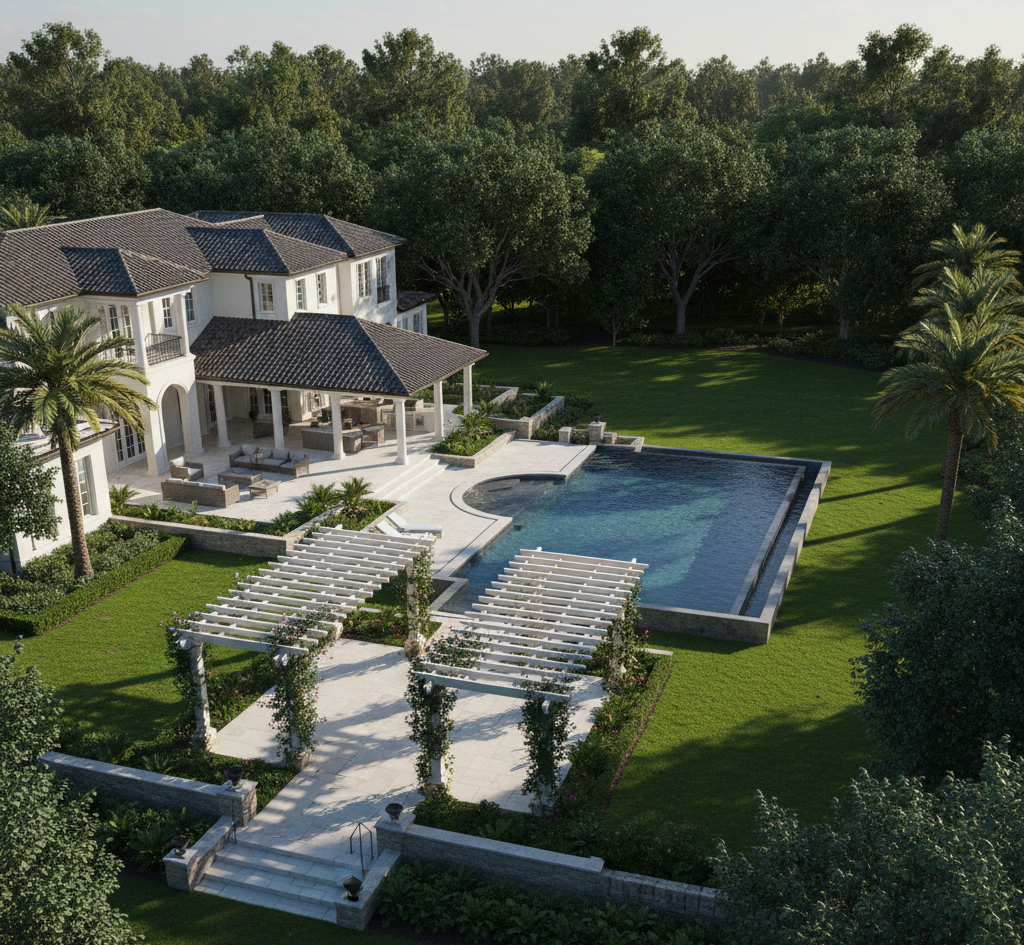
In Southwest Florida, outdoor living succeeds or fails on one variable:
Shade.
Not furniture.
Not finishes.
Not style.
On large properties in Naples, Port Royal, Quail West, etc… , most outdoor living spaces that go unused share the same problem:
They are technically beautiful—and practically unbearable.
After years of designing and correcting estate-scale outdoor living projects, the pattern is consistent:
shade planned late becomes the most expensive mistake.
Here is what actually works in this climate, and why most solutions fail.
Quick Answer (TL;DR)
In Naples, effective shade comes from:
Permanent roof structures for primary living areas
Correctly oriented pergolas for filtered light and airflow
Long-term tree canopies planned years in advance
Layered systems on large properties
Temporary or decorative shade rarely solves comfort long-term.
Why Shade Is More Difficult in Naples Than Most Homeowners Expect
Three conditions make Naples uniquely unforgiving:
High sun angles most of the year
Extreme radiant heat from pavers, pools, and walls
Low tolerance for wind-blocking structures on open lots
This creates predictable failures:
Umbrellas that rotate uselessly
Small pergolas that cast shade in the wrong place
Fabric systems that deteriorate quickly
Heat trapped under low roofs with no airflow
In this climate, shade design is not about products.
It is about solar geometry, orientation, and airflow control.
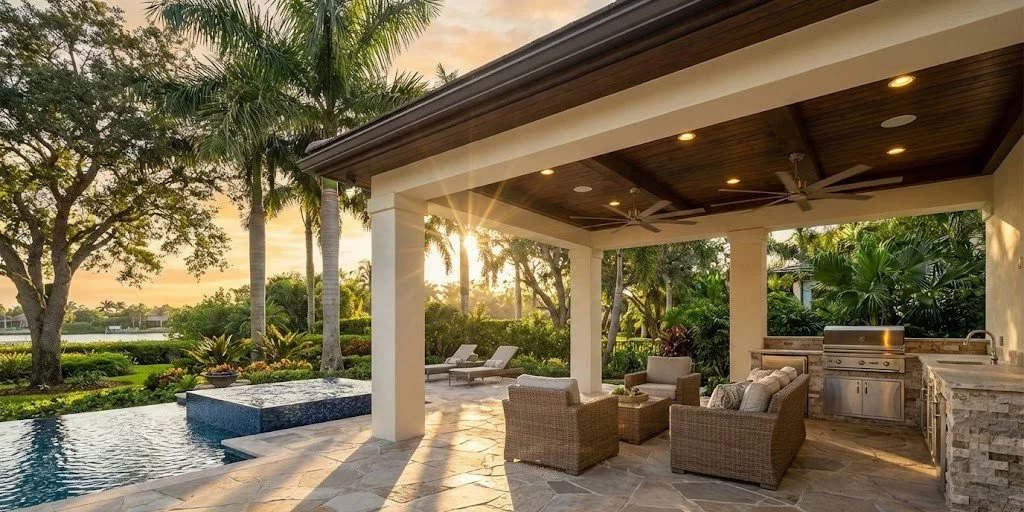
Option 1: Solid Roof Structures (The Only Fully Reliable Solution)
For primary outdoor living zones, nothing performs like a permanent roof structure.
Best used for:
Main seating areas
Outdoor kitchens
Dining spaces
Daily-use zones
Why they work:
Full solar protection
Rain protection
Structural longevity
Integration with fans, lighting, and mechanical systems including screens
On large properties, the most successful outdoor living spaces almost always include at least one fully roofed zone.
If the space is intended for daily use, filtered shade is usually insufficient.
Option 2: Pergolas (High Risk, High Reward When Done Correctly)
Pergolas are the most misunderstood shade structure in Florida.
They only work when engineered to the sun path.
Best used for:
Transitional areas
Walkways and connectors
Secondary seating
Filtered-light zones
Common failures:
Slats oriented incorrectly
Structures undersized for the space
No study of morning vs afternoon sun
No allowance for seasonal sun movement
Critical:
A properly oriented pergola can reduce heat dramatically.
A poorly oriented pergola often provides almost no usable shade.
An underutilized solution is combining pergolas with vines and plantings on top of the pergola. Combining structural and natural shade.
Option 3: Tree Canopy (The NATURAL Long-Term Tool)
Trees are the most effective natural shade source on large properties—and the most misused.
Best used for:
Large estates
Western sun exposure
Pool decks and lawn edges
Long-term master planning
Design considerations:
Mature canopy size
Growth rate
Root behavior near hardscape
Wind and hurricane tolerance
Estate strategy:
The best shade plans combine:
Structures for immediate comfort
Trees that take over in 5–10 years
Trees are not a short-term solution.
They are an infrastructure investment.
Option 4: Adjustable Systems (Useful, But Rarely Primary)
Retractable screens, louvers, and motorized systems provide flexibility—but introduce risk.
Best used for:
West-facing exposures
Multi-use rooms
Seasonal sun angles
Limitations:
Mechanical wear
Wind vulnerability
Higher maintenance
Shorter service life than fixed structures
These systems are excellent secondary tools.
They are rarely sufficient as the primary shade solution on estates.
The Shade Mistakes That Cost the Most on Large Properties
We are typically called after these mistakes are already built:
Shade added after hardscape layout is fixed
Structures placed without sun-path analysis
No airflow planning
Trees planted too close to pools or foundations
Decorative shade used as permanent infrastructure
Result:
Outdoor spaces that look finished—and remain unused 6 to 8 months per year.
How Shade Is Designed on large Properties
On large Naples properties, shade must be treated as core infrastructure, not decoration.
We evaluate:
Seasonal sun angles
Morning vs afternoon use
Prevailing wind patterns
Reflected heat from surfaces
Future tree canopy growth
The objective is not maximum shade.
The objective is usable comfort at the right times of day.
What Works Best in Naples (Quick Comparison)
| Shade Method | Performance | Best Application |
|---|---|---|
| Solid roof structure | Excellent | Primary living areas |
| Pergola (properly oriented) | Good | Transitional spaces |
| Tree canopy | Excellent (long-term) | Large properties |
| Adjustable systems | Moderate | Secondary zones |
| Umbrellas / fabric | Poor | Temporary use only |
Frequently Asked Questions
Is a pergola enough shade in Naples?
Sometimes. Often not. Only when properly oriented and scaled.
Do trees really cool outdoor spaces?
Yes—but only after several years of growth.
Are fans or misting systems a substitute for shade?
No. Shade reduces heat at the source. Mechanical systems only manage symptoms.
Should shade be planned before hardscape?
Always. Shade placement should guide layout—not follow it.
Planning an Outdoor Living Space in Naples?
On larger properties, shade is one of the most expensive things to correct later.
A short planning conversation can determine:
Where permanent shade is mandatory
Where filtered shade is sufficient
How trees should be phased
How comfort will evolve over time
👉 Request a consultation with Precision Landscaping & Design to evaluate shade strategy before layout decisions become permanent.
Final Reality Check
In Naples, outdoor living spaces rarely fail because of design style.
They fail because people cannot comfortably sit there.
Shade is not an accessory.
It is the foundation.